Tatra T815
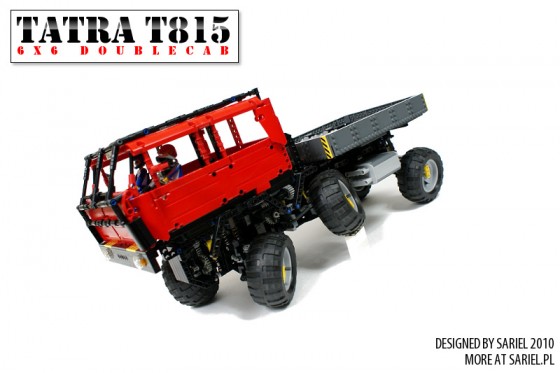
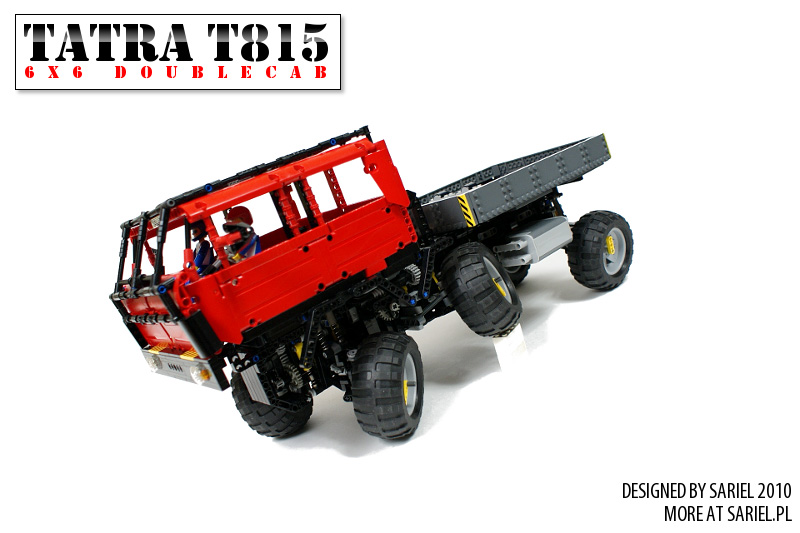
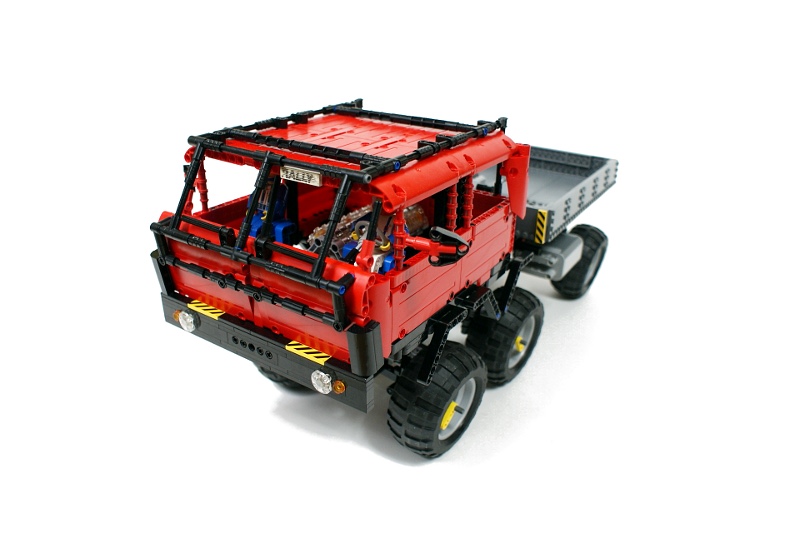
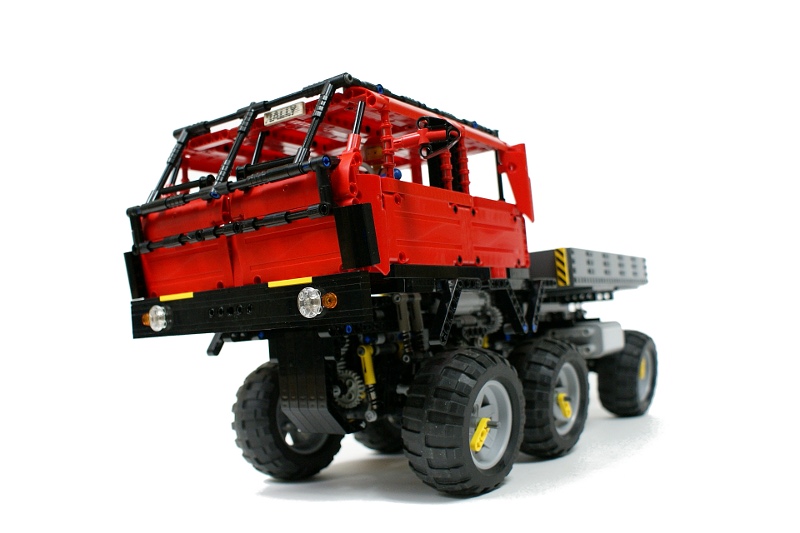
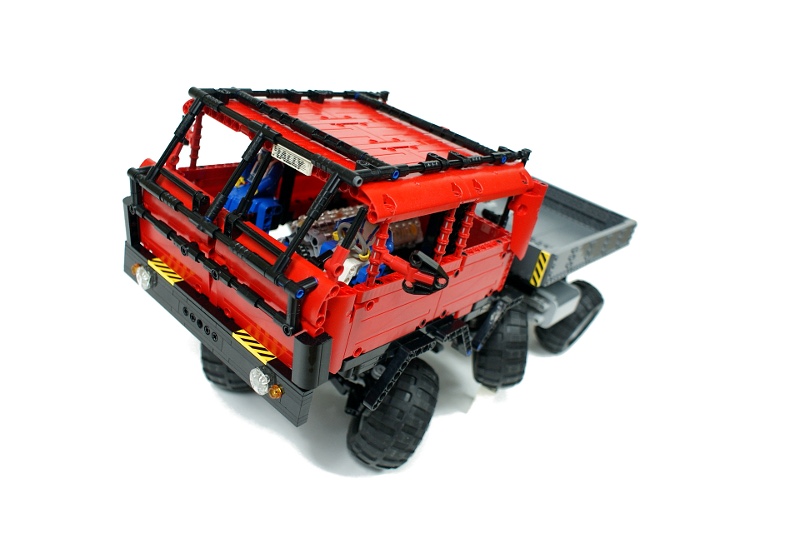
My first Truck Trial vehicle for 2010. Features 6×6 drive and full independent suspension.
Datasheet:
Completion date: 10/04/2010
Power: electric (Power Functions)
Dimensions: length 66 studs / width 25 studs / height 31 studs
Weight: 2.624 kg
Suspension: full independent with swinging half-axles
Motors: 1 x PF Medium, 2 x PF XL
My first 2010 Truck Trial vehicle had a rather difficult creating process. Even though I started to build it more than a month before the race, the final version was created under two weeks time. It was mainly because of the chassis, which wasn’t stiff enough to handle the torque of two PF XL motors, and got completely rebuilt three times.
The goal of the Tatra was to have a realistic suspension with swinging half-axles which are typical for all Tatra trucks. It was achieved by removing differentials and transferring the drive with the knob wheels. The modern Tatras have their half-axles offset a bit – this was not modelled in order to keep the steering system simple and sturdy.
The steering system was located entirely between axles 1 and 2 and consisted of two complex sliding beams with links. The beams were sliding in different directions for axle 1 and 2 and were controlled by a driveshaft whose direction of rotation was inverted in between these axles. Because of insufficient internal space both beams were given the same gear ratio, resulting in an identical steering lock of both axles.
The drivetrain was kept as simple as possible, and the main portion of it, including the drive motors, was located between axles 2 and 3. Both drive motors were located between two stringers of the vehicle’s frame, one behind the other, and were not connected directly but by a common driveshaft located beneath them. Since the space between axles 1 and 2 was occupied by the steering system, an extra driveshaft was needed to transfer the drive to axle 1. It was located above the axles, under the cabin, and it transferred the drive to a V12 piston engine located inside the cabin as well. Thus the transmission of the axle 1 was located in front of it and in order to prevent such a vital mechanism from damage, a cover made of liftarms was installed before the axle.
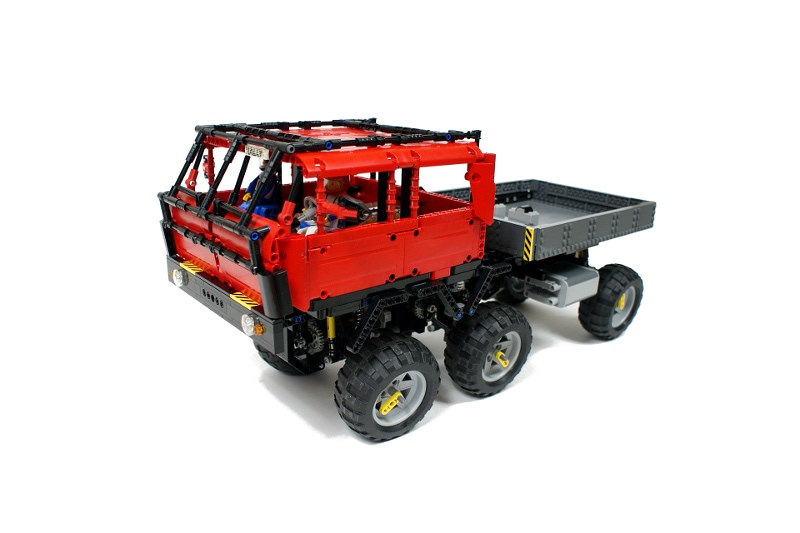
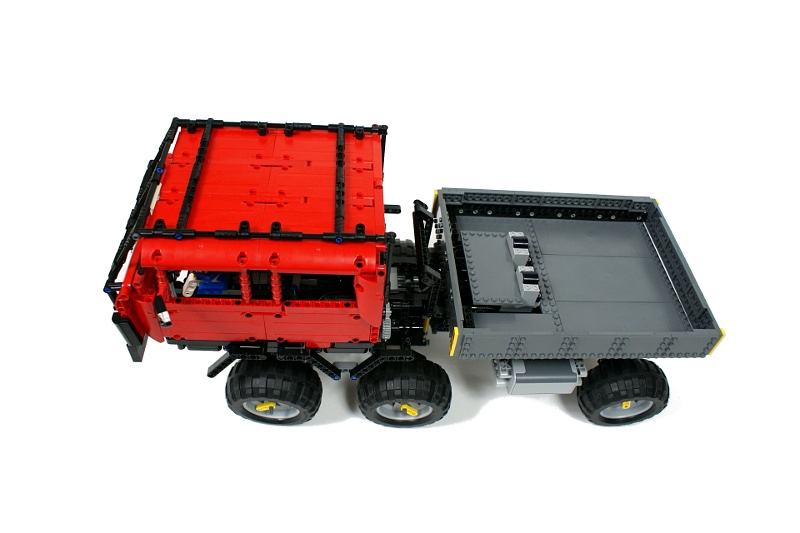
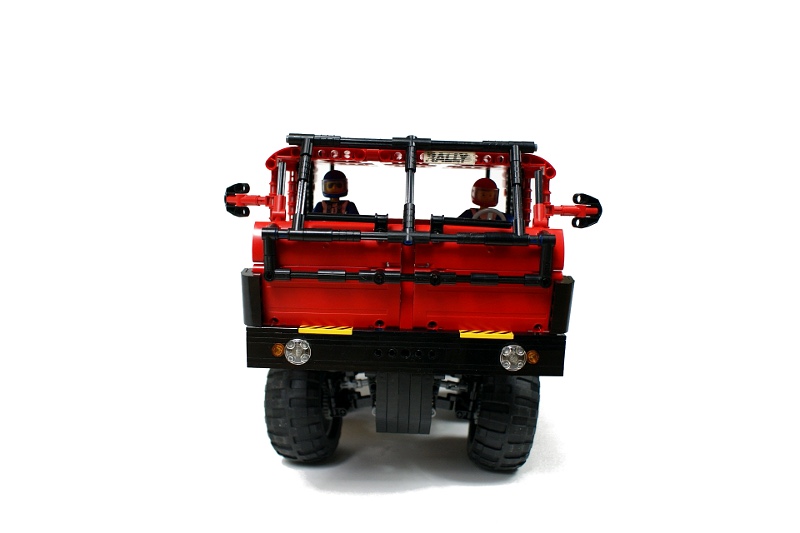
The body of the truck was rather simple, with the cabin built almost exclusively with the new Technic panels to reduce its weight. The cargo case was simple and shallow, and there was a transportation handle built into vehicle’s frame behind the cabin – a solution I’ve used in some of my earlier Truck Trial vehicles, and which proved very useful as every Truck Trial race involves a lot of carrying the vehicles around. The cabin had a safety cage built on it, which was meant to give it extra stiffness and a more Tatra-like look, as the real Tatras participating Truck Trial races are always equipped with distinctive external safety cages.
The Tatra suffered from the same thing that most of my earlier Truck Trial vehicles did – insufficient amount of testing. The problem with this kind of vehicles is that they can be only fully tested once finished, because test are most revealing at full vehicle’s weight. As you can guess this implies that a finished vehicle has to be taken back apart if it fails tests, and to avoid this arduous procedure it is a common practice to test just the chassis alone with extra load on it simulating the anticipated body’s weight. It doesn’t always work as it’s difficult to precisely anticipate the final weight of the body if it wasn’t built yet, and it’s almost impossible to simulate its exact weight distribution. I have to admit that being short on time, I have only given a minimal amount of testing to the final version of the Tatra – this was also because I was afraid of damaging it right before the race.
During the race, the model experienced two problems – the first was a failing transmission to the front axle, which snapped. There were also minor problems with axle 3, which meant that only the middle axle worked at full efficiency, and it didn’t really help while climbing obstacles. The reason was a faulty construction of the chassis – the suspension itself worked fine, all the snapping occurred in the transmission system inside the chassis. The second problem was sideways stability. While building this model, I have given a lot of attention to make sure its weight distribution prevents it from falling forwards or backwards – and I succeeded. The sideways stability, on the other hand, proved much below what could be expected. It seems that the problem was not related with this particular vehicle but with this type of suspension in general, as exemplified by another Tatra model, the T813 built by Lomero and used in the same race. His Tatra had the same suspension type while keeping a considerably lower silhouette which suggested a better stability. Surprisingly, it kept tumbling over a couple of times per each section of the race. It convinced me that it’s practically impossible to model the Tatras’ suspension system in such a way that the resulting model is stable.
Finally, the model’s drivetrain was pretty much obsolete in terms of the rules used in Polish Truck Trial. The rules take power-to-weight ratio of each individual vehicle into account in order to prevent builders from winning by simply adding more drive motors. Each vehicle is given its own points conversion rate based on its power-to-weight ratio, which basically means that you can win with a vehicle that can race despite having a very low power-to-weight ratio (resulting in high points conversion rate) or with a vehicle that has a high power-to-weight ratio but is very fast and can complete the race in short time. Tatra was neither of these cases – it had a relatively high power-to-weight ratio because of two PF XL motors, while not being really fast. The current tendency among the top Truck Trial builders is to use complex gearboxes with 3 or even 4 gears available. Thus even a truck which is much heavier than Tatra can be driven by a single PF XL motor whose gear ratio is changed as needed by the means of the remotely controlled gearbox. This results in a models that are slow but still capable, while having an extremely high points conversion rate. Two good examples of such trucks are Emilus’ GINAFs and Atr’s Volvo – both being large, heavy, and driven by a single motor.
Upon observing the race, I’ve decided to abandon the Tatra project. While the transmission problems could be solved given a sufficient amount of testing, the suspension system would still not provide satisfying stability. With the next race being only two weeks away, I decided that I would focus on building a new, small, lightweight and efficient vehicle rather than fixing Tatra. This is also the reason not to document the Tatra’s technical solutions – I think it’s better to build something more successful and then document it once it’s solutions are proven in a race. Right not I have a complete front suspension of my next Truck Trial vehicle, which looks very promising, and if it succeeds in the race, I intend to publish a complete instruction for it.
Photos:

@Tom
You usually hear if there’s a damage occurring. Cracking sounds, you know.
I’m not quite sure I understand the wall test you did. How can you tell if the motor stalls without damaging the drive train? Thanks.
@Jack Evans
Maybe this will help: http://www.youtube.com/watch?feature=player_embedded&v=94FOsEpT-9U
I can’t comprehend Tatra suspension- could you direct me to a website/set of instructions that would help me?
@gabry
Thank you, but that doesn’t really make me fit for judging others.
@Sariel
oh sorry, I asked you ’cause you are one of the most famous and intelligent builders I know… Thank you the same 😉
@gabry
I’m just a builder. Judging other people’s creations is not my business, and I’d rather keep it that way, thank you.
@Sariel
can I ask why?
@gabry
No, thanks.
@Sariel
However I hope to hear from you an opinion about my version of this truck. Best wishes.
@gabry
No idea. I must have deleted it for a good reason, such being repetitive.
I posted a comment, why has it “magically disappeared”?
i cant understand why tatra used 2 front axles, i thick its better to have 2 rear axles
@Nate
Sorry, I don’t remember. Probably between 5:1 and 9:1.
What is the gear ratio for it?
@Ramacco
No.
Hi Sariel,
Do you know how many studs there are between the 2nd and 3rd axle?
Ramacco
@Marco Ryu
No, I can’t make instructions for anything.
Could you make pdf instructions of the cabina?I have a Tatra t815, I like it…but the cabina don’t like that I would. thanks
sorry for the english, but I can’t speak english very well, I’m italian
@FanaticD
Because it works well for them.
@Sariel
yes but why tatra trucks do it that way and not as a normal car?
@FanaticD
Because it’s Tatra suspension.
hello!
i have been looking at your creations and are really awesome!!!
but i have a question… why does it have that strange suspension in 45 degrees??
@Bullet for my Valentine
I have no idea.
The Tatra T185 is one of the best trucks you ever made, sariel. I hope, that you build other trial trucks. But how mutch is it worth?
@Adam
I love this question. That’s why I put the answer in almost every single video and in the FAQ section at my website.
Where do you get all of your pieces from? You have a bunch of tires and many many building beams. Are they just from sets? Or do you just buy the tires?
@Jade2448
No, I can’t show it, basically because this model doesn’t exist since over a year.
i found a way you can make it more stable, you do it by having a heavy object like a battery box and making it be able to move side to side but that needs to be motorized by using worm drive
hi, I am making my own tatra t815 like yours but i do not how to make the front suspetion so can you show how you used it and when i am finished i will tell you and post it on youtube.
sweet i finally got them to work any tips for building a Tatra
@David
They’re good because they’re stiff.
r the yellow shock absorbers good for offroad mine dont work well there stiff
@Tore
To control gearboxes and such.
I have seen in your truck trial videos that someone drive with 2-4 rc controllers. Do you know why?
@adam
English please.
ahoj sariel chci se zeptat jestli bys mi prosimte nemohl zaslat navod k teto tatre miluju si staveni s lega a mym snem je postavit si neco takoveho
The whole suspension was raised, mat.
was the cab supposed 2 b up that high (in the real tatra), or was just 2 accomodate the fake engine
dobra, nie było pytania 🙂
@Pontoos
Pierwszy raz o nim słyszę.
cirocclo- taki duży i frogi sklep z lego w wawie.
@Pontoos
W czym?
z pytań: czy w ciroccolo można kupić jakieś fajne kółeczka do trialówki?
Za Thunderstruck masz dużego plusa 🙂
@matthew
One for him, one for his brother.
Why did Emilus make 2 of exactly the same truck???
@nxtinventor
As you can read in the description, there were problems with sideways stability.
it seems very high off of the earth… do you have any flip over problems?
@Tom
No.
can you use halftracks in this contest
@Esteval
1. Yes.
2. No. This handset is really not suitable for steering.
Hey Sariel, brilliant truck, the exterior really is amazingly realistic despite its simplicity. I wish you good luck on the jeep. I have two questions.
1. For the jeep, will you be using portal gears such as on Atr’s Willys?
2. When using the 8885 remote, can the steering motor go to an intermediate position, rather than having to go all the way to the right or to the left?
Thank you!
@Ogden
Who says it’s powerful? We’ve been using these motors like 2 years ago, they’re thing of the past.
If you really want to win the truck trial, why not use the all powerful RC race buggy motor? ( http://www.bricklink.com/search.asp?pg=1&colorID=11&itemID=37545&sz=10&searchSort=P ) Along with the RC buggy radio control and reciever? ( http://www.bricklink.com/search.asp?colorID=11&itemID=37546 ) ( http://www.bricklink.com/search.asp?colorID=11&itemID=48580)
@NXTnut
1. It’s both adults and kids.
2. Obviously not.
I have 2 questions about the truck trial;
1. Can children participate in the truck trial or is it adults only?
2. can use tanks?
@ejaurand
No one uses CVT in Truck Trial so far. The gearboxes are used for both situations you’ve mentioned, that is speeding up when possible and gearing down when needed. There is no standard setting as each section of the race is different. Drivers select proper gear prior to starting a section, and change it while driving as needed.
I saw that you mentioned gear boxes. Are these used to power down for tough situations (like low range) or for extra speed on the easy stuff (normal/high range)? To clarify, are the trucks typically run in the top gear, or do they have to start low and shift up after they get moving? Also, do you know if anyone has used a continuosly variable transmission, like the one you posted pics of on you facebook page, in a trial truck? Loved the your truck, but have to wonder if how real Tatra’s combate the problem with roling over.
@Lee
You can use it to have return-to-center steering with a PF Medium motor, but there’s a risk of damage to the motor.
Hi, what do you think about a Steering with this piece: x928cx1 (at BrickLink). got the idea from YouTube…
On my models ist works!
Lee
Maybe the problem with the suspension is that the wheels are too much offset of the verticular angle. But I guess you don’t really have a choice, you gotta have ground clearance… Goood luck with your next attempt!
Sariel used TWO FULL(6batteries) battery boxes for much voltage for each XL
Both XL’s were used in the SAME driveshaft, powering all 3 axles TOGETHER.
The motor setup was ok, but the rules give – (well kind of) points for 2motors
I hope that you do instructions for the frontaxle =)
@Arjan
Lewis and Arjan, why are you asking about something that is clearly explained in the description and shown on photos? You want me to copy-paste it for you or something?
Nice creation. Do you used 2 battery boxes or one? and did you connected the motors to each other?( did you used one motor to drive one axle and the other one for the rest of the axles?).
did you use differentials or just beval gears
Too bad that your trucks haven’t been so succesful in the races.
I hope that the jeep turns out well!
I really like how your models turn out looking just like real ones.
After the next race, could you try a simple gearbox, as they seem to help alot.
nice trial truck 🙂 – i’m building my own one and taking inspiration from unimog, but the should i use turn tables for suspension?