Tatra 813 8×8
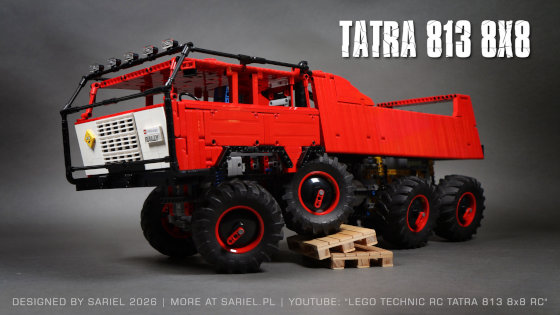
Model of a Czech off-road truck. Features drive, steering and remotely controlled transmission.
Datasheet:
Completion date: 29/06/2025
Power: electric (Power Functions)
Remote control: (Mould King control unit)
Dimensions: length 80 studs / width 29 studs / height 32 studs
Weight: 2.97 kg
Suspension: swing axles with offset
Propulsion: 2 x PF XL via a 2-speed transmission with ratios 5.4:1 a 16.2:1, constant 8×8
Motors: 2 x PF XL, 2 x PF M
Tatras have been built by hundreds, if not thousands, by LEGO enthusiasts, and I really didn’t want to add another one, but here we are. Things started because I wanted to see if the LEGO half-frame with the ball joint would work as a swing suspension arm. So I’ve built a single Tatra-style axle prototype with drive and steering and then I was tinkering with it for some time. Then came a moment where a LEGO Truck Trial race was about to be held near to where I live, so I’ve built the whole chassis, but eventually I didn’t get the chance to participate. The project still called for completion, though.
My initial chassis had all for axles spaced evenly and I was looking at a number of real trucks whose bodies I could put on it. Sadly, there aren’t exactly that many 8×8 truck with offset axles out there other than Tatras. So I’ve stretched the chassis, installing a 2-speed transmission in the middle, and I’ve built a simple bodywork based on the trucks used in real off-road competitions.
The steering was handled by a PF M motor because I wanted more torque than a PF Servo can provide. The suspension consisted of a single shock absorber per swing arm, with yellow 9.5 absorbers used everywhere except for the first axle, which – due to the weight of the cabin – required the newer and harder 9L absorbers. There was also a V8 piston engine inside the cabin, driven via a chain by the driveshaft.
The only mechanically interesting feature was the transmission, which was designed to have as little moving parts as possible, and thus reduce the risk of mechanical failure. I also wanted to avoid using the LEGO driving rings, having in memory the mechanical damage they caused to a gear wheel in my Pinzgauer 712 T 6×6 model. To that end, the transmission was shifted by forcibly pushing two 24t gears along axles, 1 stud forward and one stud back. In short, the two PF XL motors had two short axles coming out of them, each with a 24t gear on it. By sliding these gears forward and backward, it was possible to make them mesh with one or the other of the two adjacent 24t gears between them. These two adjacent 24t gears were sitting on two separate axles, each connected to the drivetrain using a different gear ratio. The rations inside the transmission were 1:1 and 3:1, and then came the 5.4:1 ratio inside the planetary wheel hubs.
The transmission worked pretty well, although moving the 24t gears required excessive force, pushing the small linear actuator I was using it near its limit. Still, all axles in the transmission were firmly supported and short, and shifting was smooth because it relied on switching from one 24t gear to the other, without any changes to the number of teeth and distances between them. On the other hand, the transmission was poorly supported inside the chassis, it tilted when shifting and it caused damage to several 8t gears acting as its output.
The finished model drove pretty well, if quite slowly. It was able to haul three chairs while also carrying extra weight on it, to climb very steep inclines, or to tow the entire LEGO Minas Tirith set. At one point its last axle was broken away from the chassis and left on the ground because I was building the chassis in hurry and didn’t support it properly. The steering worked reasonably well, while the sideways stability left something to be desired. The suspension handled all obstacles without any damage while providing travel in excess of 4 studs up/down.
As a secret feature, the rear wing, which looked rather silly on a truck this slow, was rigid enough to allow standing the truck on its back, which proved priceless when I needed to inspect or fix the chassis in the field. The model was never tested in an actual LEGO Truck Trial competition, though.