Pinzgauer 712 T 6×6
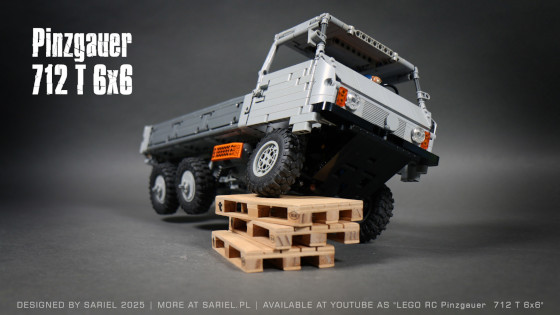
Model of an Austrian military truck. Features drive, steering and remotely controlled transmission.
Datasheet:
Completion date: 09/09/2025
Power: electric (Power Functions)
Remote control: (Mould King control unit)
Dimensions: length 58 studs / width 20 studs / height 24 studs
Weight: 1.36 kg
Suspension: front – double wishbone independent, rear – swing axles
Propulsion: 2 x PF XL via a 2-speed transmission with ratios 1:23 a 1:7, constant 6×6
Motors: 2 x PF L, 1 x PF M, 1 x PF Servo
The Pinzgauer – a name that truly rolls off a tongue – was brought into this world by the Austrian military in the 1970s, and it combines legendary off-road capability with truly exceptional ugliness in a way few vehicles ever have. Seriously, this thing looks like a flatbed tow truck violently assaulted a newspaper kiosk. I’m fairly certain that if you drove a factory-fresh Pinzgauer to a Polish body shop, the mechanic would immediately start hammering the bodywork out without even asking questions. The only explanation for the Pinzgauer’s appearance is that Austrians are probably still afraid to openly call anything ugly after that unfortunate incident with a certain failed painter. And yet, despite looking like an industrial accident on wheels, the thing is beloved by off-road enthusiasts, who routinely push it well beyond the limits of most other vehicles.
The model itself was thrown together in just two days, inspired by some smaller trial trucks I saw competing at a truck trial event, that performed surprisingly well. It turns out not everything in trial trucking has to be a gigantic monster on 16-stud tires, and smaller vehicles also have the useful advantage of easily fitting through gates. So I quickly started looking for a compact truck with good off-road credentials, and – after suppressing the urge to claw my own eyes out – I settled on the Pinzgauer.
The real vehicle uses a Tatra-style suspension setup, but I decided to go with independent suspension in the front. First, because I’d already built a Tatra-style steering suspension in this scale before and the ground clearance was terrible. Second, because I wanted to use the new short LEGO links and CV joints. To simplify the build and lower the center of gravity, I chose the real truck’s T-version flatbed body for my model, but to counterbalance the weight of the cab a bit I added an opening tailgate and dropsides with locks. For clarity, I’ve never actually seen a real Pinzgauer configured exactly like this; I completely made it up to suit my needs.
As for off-road performance, the rear tandem suspension was probably just a little too soft. It articulated beautifully over rough terrain, but it also bottomed out upward a bit too easily. The real nail in the coffin, however, turned out to be — once again — the transmission. I have hoped that serious gear reduction and reinforced chassis, combined with low vehicle weight and the LEGO rotary shifter, would be able to handle the torque, but during some harsher off-road tests, something inside the transmission made a distinct crunching noise, and the transmission barely worked ever since. After a thorough investigation I found that the inner clutch teeth on one side of a 24t clutch gear in the transmission got destroyed by the driving ring. Which probably proves that this type of transmission and LEGO trial trucks simply aren’t meant for each other.
The damaged gear is shown below (right side):

Up until the mechanical failure the model did drive reasonably well, and it even steered surprisingly decently. But it was still not easy on eyes.
Photos:


Video: