Armstrong-Siddeley Pavesi 8×8
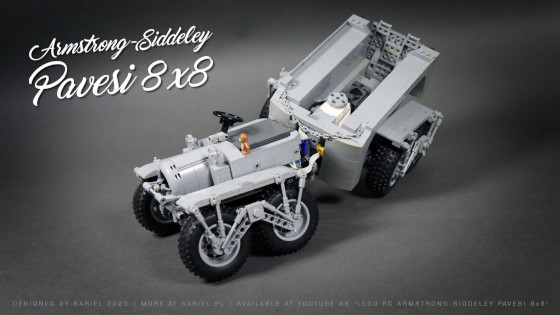
Model of a WW1 artillery tractor prototype. Features drive and articulated steering.
Datasheet:
Completion date: 20/05/2025
Power: electric (Control+)
Remote control: Control+
Dimensions: length 49 studs / width 24 studs / height 16 studs
Weight: 1.558 kg
Suspension: oscillating bogies
Propulsion: 2 x PU Large Angular geared 3:1, constant 8×8
Motors: 2 x PU Large Angular, 1 x PU Medium Angular
The story of this very unusual vehicle begins about 100 years ago, when the Italian company Pavesi introduced the P4 tractor, notable for its enormous wheels and articulated steering. For its time, the P4 had exceptional off-road capability and found many uses, serving with the Italian military, among others. In fact, some P4s were still being used by the Wehrmacht during the early years of World War II.
The British were also interested in the design — specifically the Armstrong Whitworth group, which bought a license for the P4 and passed it on to its subsidiary Armstrong Siddeley as the basis for a tractor intended for the British Army. I have no idea what the company’s standards were regarding alcohol and illegal substance use at work, but they removed the giant wheels from the P4 and replaced them with four oscillating bogies, each carrying two pairs of wheels, for a total of sixteen wheels. Then, apparently deciding the machine still wasn’t strange enough, they replaced the original engine with — and this is not a joke — a radial aircraft engine.
Records show that the British Army tested this creation in field trials around 1932, and that’s where the trail goes cold. We can only imagine what the officers said about it, especially considering the legendary reactions British officers often had to unconventional military designs. Rumor has it that when the Americans proposed the Republic P-47 Thunderbolt — the largest fighter aircraft of the entire war, shaped roughly like a cow with wings — the British reportedly stared at it for quite a while before one officer finally remarked: “Well, at least our bombers will be able to hide behind it.”
As for the LEGO model itself, I only had a few days to build it, and my original ambitious plan was to use a single drive motor with a shaft running through the articulation joint and a whole pile of bevel gears. Then my trial trucking friends convinced me to stop overengineering things and simply put one motor in each axle without connecting them mechanically. The upside was that it eliminated all the bevel gearing. So that’s exactly what I did, and I chose to use the tires from the Technic LEGO Technic Ford F-150 Raptor, with two tires per bogie instead of four, because it’s hard to find sufficiently narrow tires at this scale — plus I was hoping for decent traction.
Of course, weight distribution became a major challenge, which is why I placed the Smart Hub and batteries in the front half of the vehicle, where they completely fill the cabin interior. Steering was controlled by a motor mounted at the rear of the vehicle, operating two small linear actuators. That choice was dictated by limited space and by the fact that the actuators are relatively safe — they have internal clutches, so there’s little risk of the steering system tearing the whole frame apart under load, which could easily happen with something like a worm gear driving a regular gear.
In the end, the model competed in the trial event and provided all of us with plenty of entertainment — mainly because it failed the first two sections out of four, and in the second one it didn’t even make it out of the starting gate, burying itself in the dirt and ending up stuck on its rear end. On the upside, it was nearly unstoppable at climbing slopes as long as their surface was reasonably even.
The main issues when traversing difficult terrain proved to be the mediocre ground clearance (mere 3 studs under the axles) and poorly performing steering (it could barely steer at a standstill because there wasn’t enough torque, and steering while moving was much too slow). On the plus side, it certainly didn’t lack torque, there were zero mechanical failures, and I was pleasantly surprised by the tire grip. Sadly, the model spent too much time getting hung up on anything sticking out of the ground and lining itself up for gates with all the grace and agility of an aircraft carrier to be actually competitive.
I still think this type of setup has huge potential, but it absolutely needs greater ground clearance and a much more capable steering system. And then there are the bogies, which in my model had unlimited articulation – only stopped by the bodywork in front – resulting in various bits of the cabin getting knocked off as the suspension worked. Additionally, it didn’t help that the front-end was fragile and built using 5-sided SNOT technique, because that made rebuilding during competition it a nightmare.
Work in progress photos:


Photos:


Video: