Flamethrower Tank
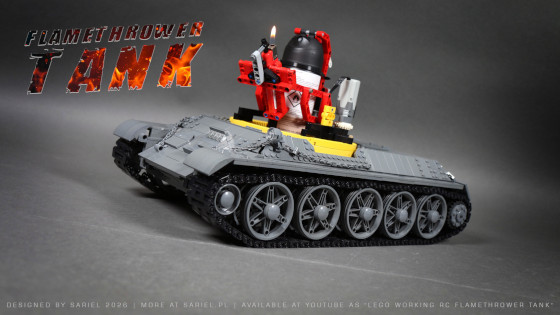
Model of an tank based on T-34, with a remotely controlled flamethrower in place of the turret. Features drive, steering and remotely operated flamethrower mechanism.
Datasheet:
Completion date: 13/01/2026
Power: electric (Power Functions)
Remote control: (Mould King control unit)
Dimensions: length 58 studs / width 28 studs / height 30 studs
Weight: 2.548 kg
Suspension: Christie
Propulsion: 2 x PF XL geared 3:1
Motors: 2 x PF XL, 2 x PF M
I originally started building the T-34 in a larger scale around 2020, but I couldn’t quite figure out what new features to put in it that I hadn’t already tried before. I experimented with tracks made from rubber connector links that could climb practically anything but had a tendency to disintegrate after a while. I tested a recoil simulation system where “firing” the gun would actually shove the entire tank backwards, but it wasn’t very efficient. I also built a version with a 4-speed gearbox connected to two separate steering gearboxes, so each track had its own selector with stop / half speed / full speed settings.
The idea behind that last setup was to replicate the steering system of the T-55, which I once had the opportunity to drive around a military training ground. What I ended up with instead was an enormous, wheezing, farting mechanical monstrosity occupying the entire hull, where making a gentle turn required a PhD in mechanical engineering and bringing the thing to a stop required divine intervention.
Then, somewhere along the way, the whole “3-day special military operation” situation started, and somehow I lost enthusiasm for building Russian military hardware. So I shoved the unfinished chassis onto a shelf and waited to see what would happen next.
Finally, 2026 came and the “special operation” was still more or less where it started, and I was getting desperate to finally get this project off my list. That’s when I found inspiration in the Hungarian Big Wind project — a firefighting machine consisting of two Mikoyan-Gurevich MiG-21 jet engines mounted on a T-34 chassis. Apparently some Hungarian engineer, presumably marinated in Tokaji wine, decided that instead of extinguishing fires conventionally, it would be more efficient to simply blast them out of existence with hurricane-force jet exhaust. Supposedly, it actually worked.
So, being a bit of a pyro, I took the unfortunate T-34 chassis, replaced the turret with an aerosol can and a cigarette lighter mounted on a remotely rotated and elevated mount, and called it a day.
I deliberately left everything above the hull completely exposed, partly in case something started melting or burning, and partly because given the very real possibility of the can itself catching fire and exploding, I preferred to keep an eye on the it at all times. The entire build used genuine LEGO parts except for the aerosol can, the lighter, and the two zip ties holding the can to a liftarm — because I really didn’t feel like testing what happens when a pressurized canister becomes loose while spraying fire.
The lighter was ignited manually, after which I slid a LEGO axle forward to hold down the trigger. The aerosol can itself was pressed remotely using a PF M motor and a small linear actuator. A second PF M motor handled turret rotation, while two LEGO Power Functions XL Motor motors powered the drivetrain.
Amazingly, the entire contraption worked exactly as intended, and somehow not a single LEGO piece melted. It probably helped that I filmed it in January with temperatures dropping below the -20°C area.
Photos:


Video: