Hummer H1

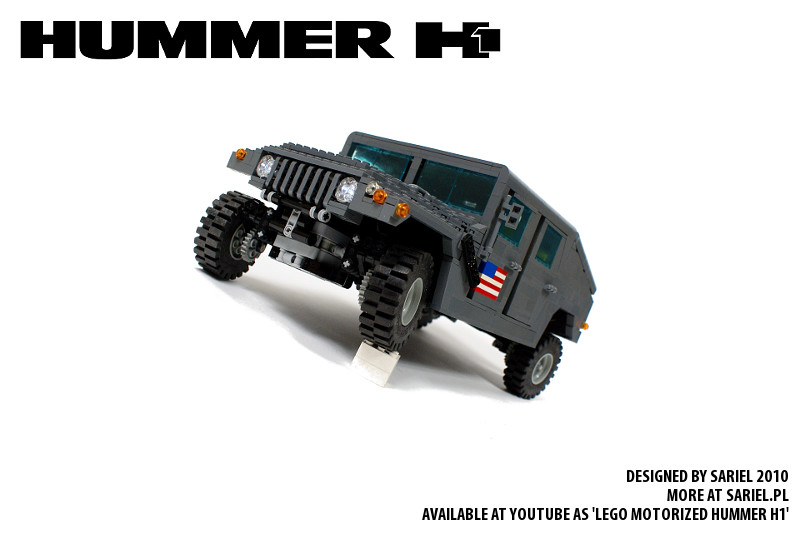
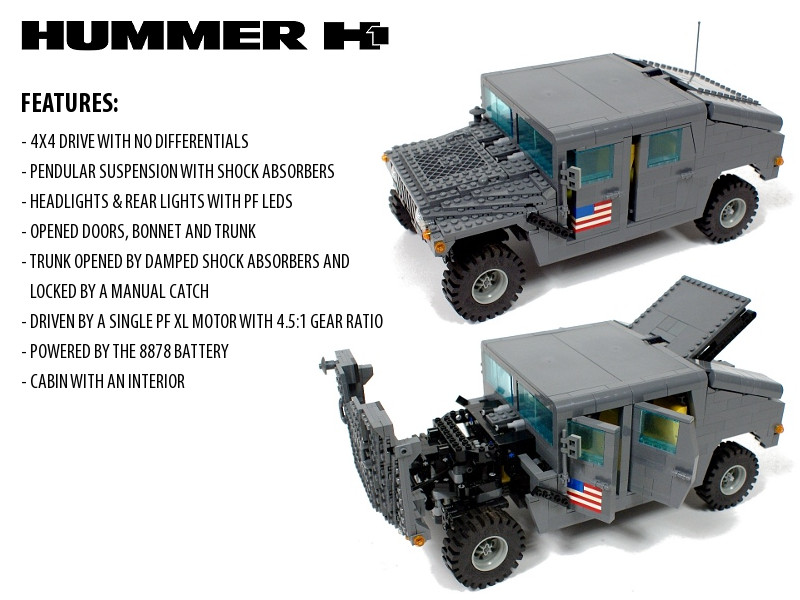
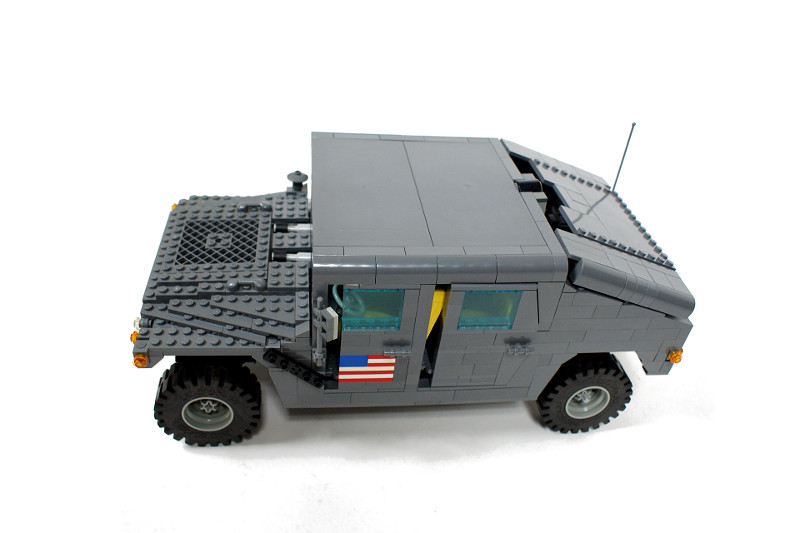
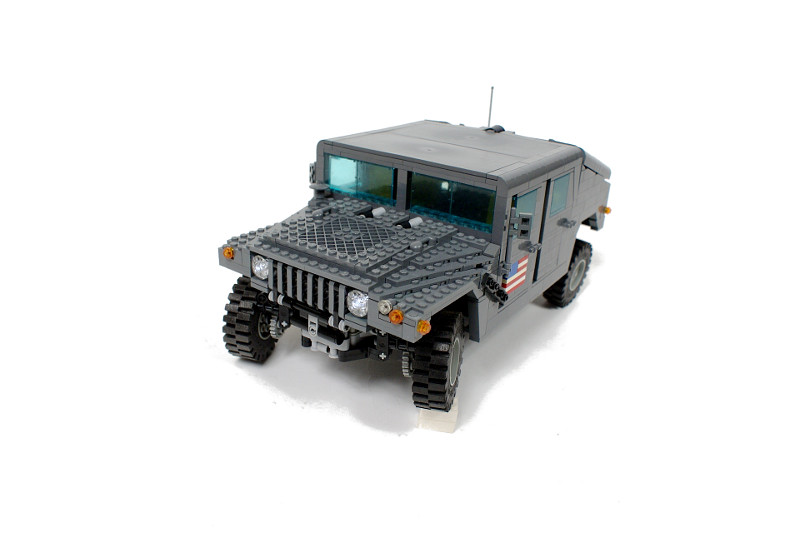
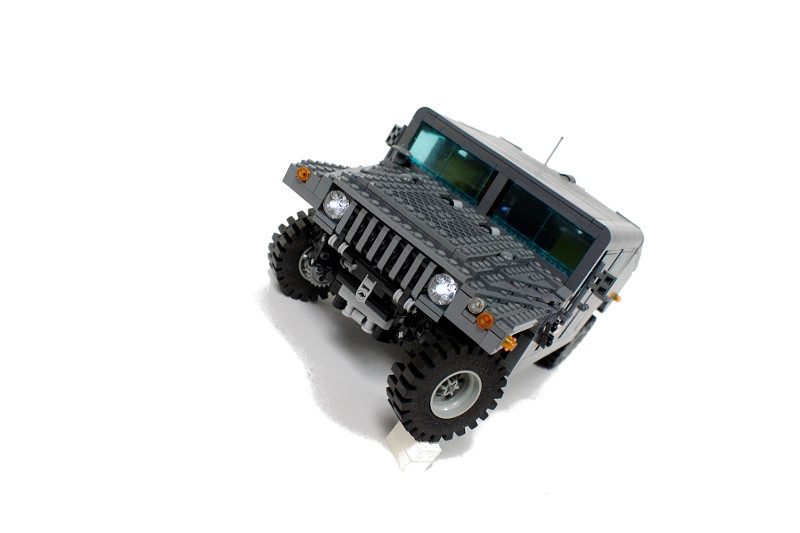
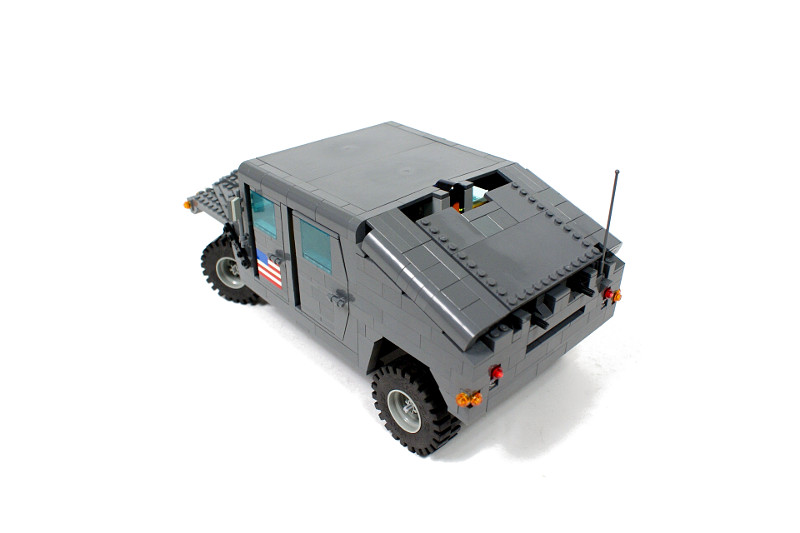
My third 2010 Truck Trial vehicle. Uses modified Jeep Wrangler’s chassis, features 4×4 drive, full suspension, opened doors, bonnet and trunk, headlights and rear lights with LEDs.
Datasheet:
Completion date: 21/05/2010
Power: electric (Power Functions)
Dimensions: length 41 studs / width 20 studs / height 19 studs (not including aerial)
Weight: 1.518 kg
Suspension: pendular, stabilized with 2 shock absorbers per axle
Motors: 1 x PF Medium, 1 x PF XL
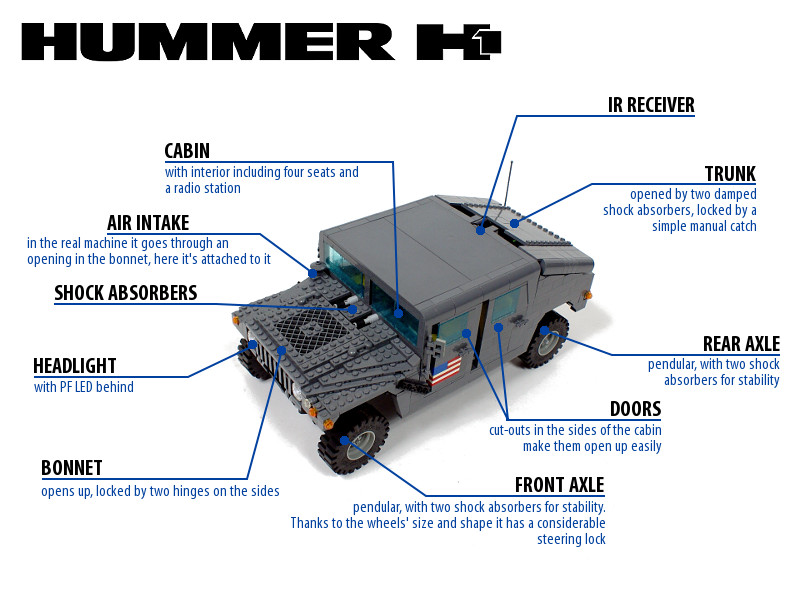
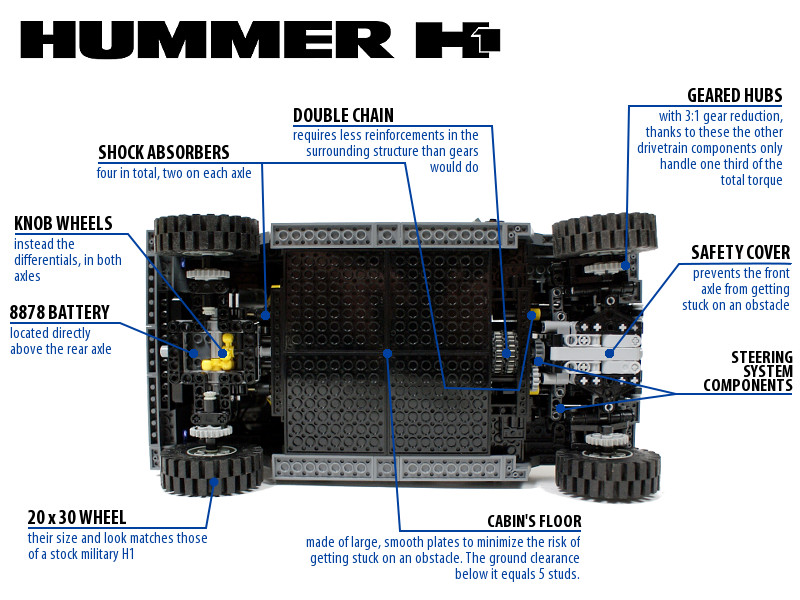
My third 2010 Truck Trial vehicle was based largely on the previous Jeep Wrangler Rubicon. It took me over a year to come up with this model since the first plans for it appeared in early 2009 and were postponed since then. It turned out to be good for the model, as I was able to build it entirely in dark gray and using race-proven chassis components. The basic chassis concept remains the same as it was for the Jeep: two pendular studless axles held together by a studfull frame embedded into the cabin’s floor. All the components taken from the Jeep have been modified though: the front axle has a modified steering system that makes the wheels protrude forwards, the rear axle is narrower, and the frame is wider and fully covered with plates from below.
My goal from the beginning was to make this model accurate, even at the cost of its off-road performance. Unlike the Jeep, this model is scaled down accordingly to our Truck Trial regulations, which makes it much smaller than usual TrTr vehicle. Therefore it was clear that it share some disadvantages with the real Hummer, such as relatively small wheels and large wheelbase with low ground clearance. The latter resulted in numerous ‘getting stuck on belly’ accidents during tests.
The Hummer is much heavier that the Jeep was, which was exactly my intent. Based on the performance of the Jeep, which had enough torque to be practically unstoppable, I have estimated that its drivetrain and chassis components should handle weight of some 1.5 kg without problems. Since our rules take power-to-weight ratio into account, heavier vehicles get more points. Therefore I was trying to achieve greater weight while maintaining Jeep’s speed and performance. The speed is almost identical, despite smaller wheels (8 studs in diameter compared to Jeep’s 10 studs), as the gearing in the drivetrain was changed from 5:1 to 4.5:1. In order to obtain this exact gear ratio I have used a double chain between the drive motor and the driveshaft. A single chain would be broken instantly, while a double chain survived all tests I’ve ran. The use of a chain had one extra advantage: it required much less reinforcements in the surrounding structure that the gears alone would, since the gears were, well, chained together. Eventually, there were some minor inaccuracies in the model as compared to the real H1. The bonnet had a cut-out section in the middle of it, which was necessary to accommodate for the upper ends of the front shock absorbers. The air intake, which in reality is fixed to the chassis and goes through an opening in the bonnet, was attached to it in the model. I have also reduced the size of the front bumper and gave up some extra elements such as the famous “cow catcher” in order to achieve a better approach angle. Finally, there were openings in the sides of the cabin that allowed the doors to open up easily, as there was not enough internal space to use opposing hinges and I didn’t want the doors to require force to open.
The model participated in a Truck Trial race on May 22nd, and it generally performed above my expectations. It had sufficient torque and displayed some excellent manoeuvrability. The stability was satisfactory, except for one incident when I managed to flip the model over somehow. There were some traction problems, but not larger than those experienced by other vehicles (we keep having problems when driving on a dry forest bed). After the first section of the race Hummer placed 4th out of 11 vehicles, which was partially thanks to the power-to-weight ratio more favorable than it was for the Jeep. During the second section it easily climbed over a large branch that seemed too big for its ground clearance. Then during the third section both chains in the drivetrain broke at once. Since it was impossible to fix it on the field (large portion of the cabin had to be taken apart to access the chains, and I needed tweezers), I was forced to give up the rest of the race and thus the model ended up on the last place. It seems that the model had a considerable potential and could effectively compete against larger vehicles, but the idea of using chains in the drivetrain was clearly wrong. The thing I’m happiest about is that I’ve finally managed to put the damped shock absorbers to some practical use, even if it didn’t look as good as simple plates on hinges would.
Photos:




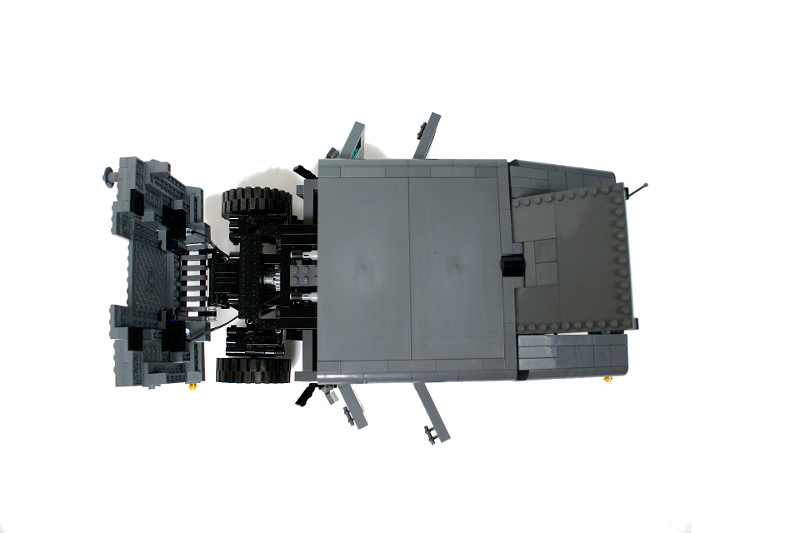

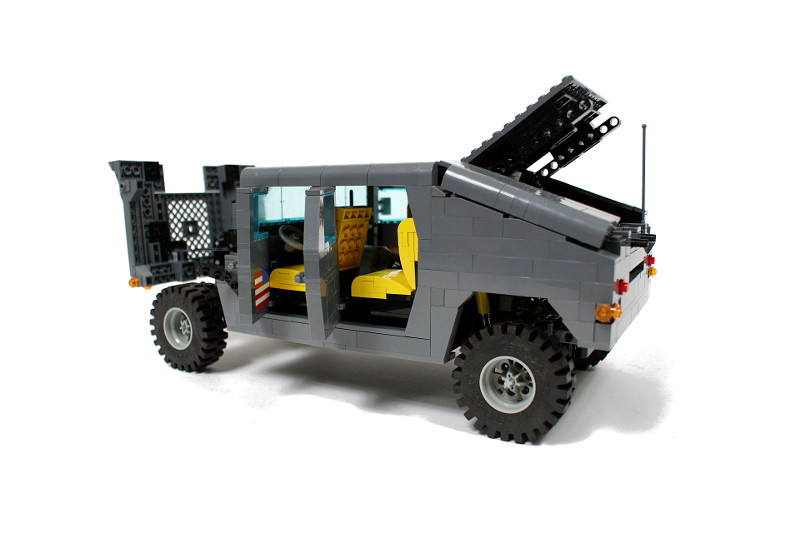




@Sariel
It’s a nice model. I’ll send you some photos of the finished mod, if you agree…
@gabry
I don’t have the 8081, so I can’t really say.
Bravo Sariel! I’m studying the axles of this hummer ’cause I’m building a trial truck with the chassis by the set 8081… What do you think about my idea?
Thanks, feel like a dope now!@Sariel
Sorry ment width ways.
@Ed
I’m using half-stud wide beams between studless and studfull pieces.
Hi, this is probably really obvious, but how do you have an even number of studs length ways?
@Ruben wynia
If you have differential in the axle, and one wheel starts to slip (for instance, because it’s up in the air), the other wheel will stop, as the differential directs all drive to the slipping wheel. That’s why knobs are used instead differentials in serious off-road racing.
hello, this car is great, but why you use not a differential? i am want to make a 4×4 but i have two different differentials. wat is the different between knob wheels and the differential?
well it dosnt matter anyway cos i’ve built your lego jeep wrangler rubicon.its great if i do say so my self thanks you so much for letting us have the instructions:)
@prodan
Sorry, I didn’t make instructions for it and I don’t intend to.
please tell me from where can i download all of the instructions please make instruction ot give link i want to make hammer too.i want to make hammer just like your please send to my email instructions please i beg you
@ joe tuyger if youre so good make a better one
@nate
Of course.
are you go ing to make more truck trials?
@Joe Tuyger
If you know, why even bother asking?
Now, here’s what you’re missing: the endurance of u-joints. With an independent suspension, there would be u-joints directly at the wheels, and given the weight of the model and the obstacles we have at our races, they would break. By using pendular suspension, I was able to include 3:1 gear reduction right at the wheels and before the u-joints, thus reducing the load on u-joints three times. Don’t give me any crap about how you didn’t figure it out, I know you were just lazy and chose to not write smart.
You do know that a Hummer has Independent suspension, don’t you? (well, consumer models have front independent and rear live) This model is large enough to allow for such systems. Why you did not include it amazes me. This would not only be more adept off-road, but it would be more realistic and handle better. Don’t give me any crap about how it is not heavy enough for sprung suspension, I know you were just lazy and chose to not build it right.
Very nice, oh and for future reference “stuck on belly accidents” are commonly refered too as “being high-centered.”
Unfortunately it’s really annoying. There are many people leaving comments like these, and you wouldn’t believe some emails I receive. I know I shouldn’t react this way, but I really just want to build and not to run a kindergarten.
This is really great Sariel, I think it is one of your most accurate models, and to you did an especially good job on the front end.
One more thing, you really seem to get frustrated with all of these people asking the same questions over and over, or asking questions you have ACTUALLY answered in your post!
Good Job.
Listen tony, how about you start using your eyes by watching the photos and reading the descriptions? I really hate being asked about things that are clearly written or shown right above your own comment.
thats a cool hummer is it an all wheel drive?
Of course it won’t qualify – if there is no rear suspension, not all of the wheels are suspended. This is why I used stabilized pendular suspension here.
The truck trial rules state that all wheels must be suspended. If you build a truck with non stabilized pendular suspension on just the front will it qualify? Because if you put non stabilized pendular suspension on both the front and the back axels the vehicle would just flop over to one side.
I did. Check the Ideas category/
could you show how to make pendular suspension
Może admin nie odebrał? proszę, popytaj w moim imieniu. (jakbyś mógł)
Nie wiem jakimi prawami rządzą się te maile, jeśli nie dostałeś odpowiedzi może admini nie chcą Cię dopuścić.
Sariel, mam mały problem…
wiem że to nie dotyczy hummera, ale mógłbyś mi pomóc?
Próbuje się zarejestrować na Lugpolu, ale nie dostałem odpowiedzi na maila…
Jak się tam dostać?
I refreshed it.
Hey .. what happened to your website ?!
Lucius is AWESOME! =]
Also what song is that?
@NXTnut9
Yes, we know how differential works. The thing is, you don’t have to use it. Your Lego vehicle isn’t really going to explode if you make it turn without differentials.
I think my earlier post may have been taken the wrong way. Lewis and you are right, but when a car (or truck) steers the wheels turn part of a circle, but the radius of the circle for the outer wheel is larger than the radius for the inner wheel, thus the outer wheel has to go faster than the inner wheel, a differential makes that possible, although this is not possible with a regular axle. And I noticed the big change in the website, its great!
@NXTnut9
What for? To make my offroad performance suck?
@NXTnut9
if one wheel gets stuck in a hole the other one just spins unless you put an diff-lock which locks up the differential an traction is returned to both wheels.
Why didn’t you use a differential?
oh yeah silly me only hade time for a glance last night and didn’t have enought time to read it
@kyle
Read the description then.
love th body, was just wandering if this chassis is very similar to that of the wrangler
@NaturalBornUser
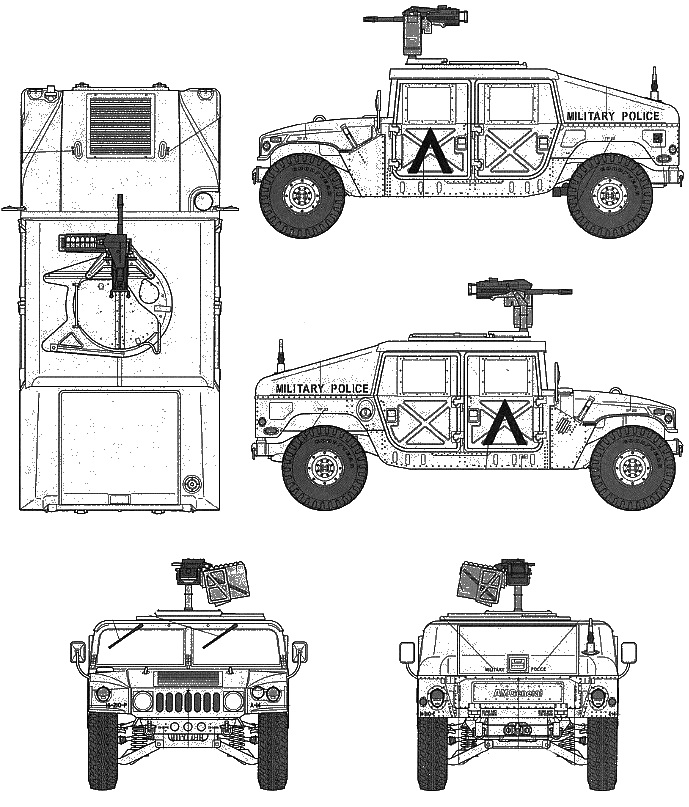
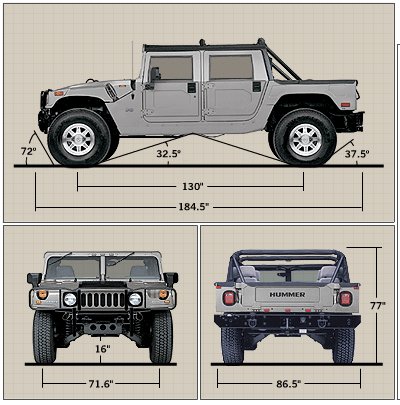
http://www.the-blueprints.com/blueprints/
Sariel skąd bierzesz plany do swoich modeli, które zamieszczasz potem na końcu galerii?
@GuilliuG
Shock absorbers are attached to the suspension.
12t gears would break or snap on first obstacle. No one uses these gears in TrTr here.
I’ve explained reasons for the chain in the description.
Great construction !
Is the shock absorver now attached to the axle?
The knobs cause accoups in the propulsion. Why don’t you remplace them by 12T double bevel?
And i don’t understand why you use chain for a TT 🙂
@Jasper
But they’re all very similar to the ones in the Jeep Wrangler, which has a complete step-by-step building instruction.
man it would be so nice if u posted more pictures of the drivetrain, steering component and all the other thecnical things in it
@Tzvetelin
Here’s the link: http://www.brickshelf.com/gallery/Sariel/TruckTrial/HummerH1/dsc04783.jpg
How much the suspension can handle depends mainly on the weight you put on it.
Could you please give me the link of picture number 22of the H1?
I am also curious – will the suspension of 8466 withstand the torque of the XL motor? It’s just
more beautiful – the point around which the front wheel steers is closer to the wheel itself. In most of your creations it is some 2 or even 2 studs away.
Cheers!
@Bart
No, knob wheels give you no differential functionality whatsoever.
@Kondzios230
Umm, I’ll check my RSS feed.
@lewis
There was another guy using chains in TrTr among us, but it was long ago, in the RC motors era. The solution could be tying a string over the chains, but I think I’ll just stick to gears now 🙂
your the first person i’ve seen using chains in trtr, pitty they broke you might have got onto the podium- if you use podiums 😛
Nice Hummer, looks very similar to original.
I have a functionality note-subscribing on google haven’t noticed posts newer than “The hand…” 🙁
good choice of music(i like linkin park)
🙂
@Sariel I thought they looked a little different, but pretty much the same
Dear Sariel,
Nice work once again!
Do the knob wheels give you any differential functionality or do the wheels at both ends of one axle just turn in the same speed, meaning one of both will skid during cornering?
@scott
Modified, not exactly the same.
nice, you used the same front and rear axel as in the wrangler
Awesome ! Great idea to change the way of building the TT, not a truck, that changes !
@333444ize
Did I, really?
you said that puts all your instructions for future models?
@David Luders
Great to hear a favorable opinion from someone who deals with H1s in real life 🙂
Thanks for sharing your Hummer H1 MOC! I work at a US Air Force base and see the real trucks quite often. You have captured the key features, and the folks I know who drive Hummers will want to build their own!